
How to Choose the Best Recliner Swivel Chair for Compact Living
Living in a small apartment or studio often feels like solving a puzzle where the pieces never quite fit. You want comfort after a long day, but that oversized sofa devours your entire living area. You crave style, but bulky furniture makes your space feel cramped and cluttered. Every square foot matters, and the wrong furniture choice can turn a cozy home into an obstacle course. This is where multifunctional furniture becomes a genuine game-changer for compact living.
Enter the recliner swivel chair—a single piece that delivers the relaxation of a recliner, the flexibility of a swivel base, and a footprint small enough to work in tight quarters. Whether you’re unwinding with a book, watching TV, or simply need a comfortable seat that moves with you, this chair does it all without demanding the space of a traditional recliner or sectional. This guide walks you through the essential criteria for selecting the perfect recliner swivel chair for your compact home, covering space planning, must-have features, style considerations, and budget-smart strategies that ensure you invest wisely.
Understanding Your Space: The Foundation for Choosing a Compact Recliner
Before browsing any catalog, grab a tape measure. Record your room’s length, width, and critically, the distance between existing furniture pieces and walls. Note doorway widths and walking pathways—you need at least 30 inches of clear passage to move comfortably through a room. These numbers become your non-negotiable boundaries when shopping.

Understanding the difference between a chair’s “footprint” and its “range of motion” prevents costly mistakes. The footprint is the floor space the chair occupies when upright and stationary. The range of motion, however, includes the additional space required when you recline the backrest and extend the footrest, plus the circular sweep when you swivel. A chair might look compact in its resting position but demand an extra 12 to 18 inches behind it and a full 360-degree clearance radius around it.
To plan effectively, mark the chair’s full range of motion on your floor using painter’s tape. Include the recline depth behind the chair and the swivel diameter around it. Live with that taped outline for a day—walk around it, open nearby doors, pull out adjacent drawers. This simple exercise reveals whether the chair truly fits your daily routine or silently steals space you cannot afford to lose.
Key Features to Prioritize in a Space-Saving Recliner Swivel Chair
This section details the essential features that address compact living needs.
1. Space-Efficient Design & Mechanism
The mechanism inside your recliner determines how much room it actually needs to function. Traditional recliners push the entire backrest backward, demanding 12 to 18 inches of clearance between the chair and the wall behind it. For compact living, a wall-hugger (also called wall-proximity) mechanism is far superior—it slides the seat forward as the back reclines, requiring as little as three to four inches of wall clearance. This difference alone can save enough space to fit a small side table or floor lamp that would otherwise be impossible to place.
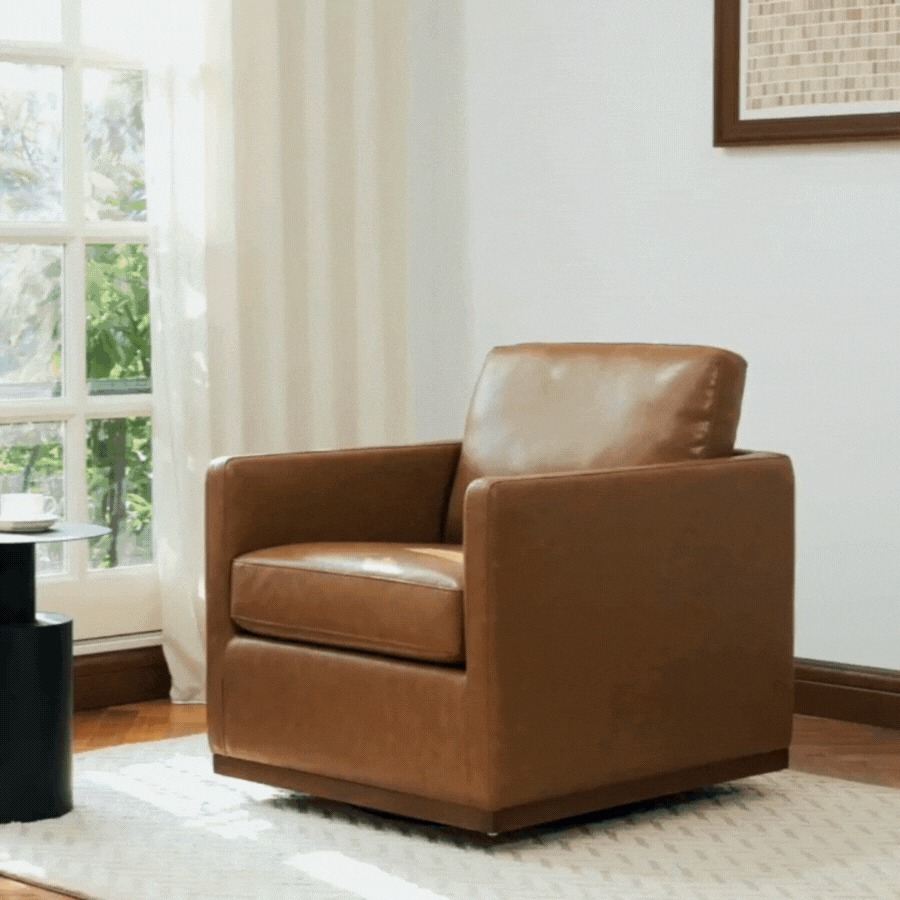
The swivel base adds another layer of functionality without expanding the chair’s footprint. A smooth, 360-degree swivel lets you turn toward a conversation, face the television, or pivot to reach a nearby desk without standing up or repositioning the entire chair. Look for a base with a weighted, low-profile design that keeps the chair stable during rotation and doesn’t catch on rugs or flooring. When the chair isn’t in use, its compact profile matters just as much—seek out models with slim armrests, a streamlined silhouette, and no bulky external lever handles that jut outward and steal precious inches from your walkways.
2. Durability & Construction: Investing in Quality
In a compact home, your recliner swivel chair isn’t a secondary seat—it’s likely your primary lounging spot, meaning it endures hours of daily use. A solid wood frame, typically kiln-dried hardwood like birch or beech, provides the structural integrity to handle repeated reclining and swiveling without loosening joints or developing creaks over time. Metal frames offer strength but can add weight, while engineered wood or particleboard frames often fail at stress points within a year or two of regular use. Brands like Chitaliving, known for their expertise in wooden furniture construction, demonstrate how quality hardwood framing can be paired with space-conscious design to deliver lasting performance in compact chairs.
Beyond the frame, the cushioning and upholstery determine everyday comfort and longevity. High-density foam (1.8 pounds per cubic foot or higher) resists flattening and maintains its shape through thousands of sitting sessions. For upholstery, tightly woven polyester blends resist pilling and staining while remaining breathable, making them ideal for daily contact. Faux leather delivers a sleek look and wipes clean easily, though it can feel warm in humid climates. Whichever material you choose, check that seams are double-stitched and that the fabric wraps smoothly around curves—these details signal construction quality that lasts.
3. Style That Complements Your Modern Life
Contemporary flair in furniture means clean geometric lines, minimal ornamentation, and a silhouette that feels intentional rather than bulky. For a compact recliner swivel chair, this translates to tapered bases, slim track arms instead of oversized cushioned ones, and smooth upholstery without tufting or excessive piping that adds visual weight. The chair should look like it belongs in a curated space, not like it wandered in from a home theater setup.
When choosing a design, consider your existing palette. A neutral chair in charcoal, oatmeal, or soft gray integrates quietly into most rooms, while a bold accent color like deep teal or burnt ochre turns the chair into a focal point that anchors the space. Texture plays a role too—a matte woven fabric softens a room filled with hard surfaces, while leather or velvet adds richness to minimalist interiors. The goal is a chair that earns its place both functionally and aesthetically.
Balancing Budget and Quality: Finding Affordable Options
Smart spending on a recliner swivel chair means understanding where your money delivers lasting value and where you can trim costs without regret. The frame and reclining mechanism are non-negotiable investments—these components bear the mechanical stress of daily use, and cutting corners here leads to wobbly joints, stuck footrests, or a chair that simply collapses within a couple of years. A solid hardwood frame and a reliable wall-hugger mechanism cost more upfront but eliminate the expense and hassle of premature replacement.
Where you can save is in upholstery selection. A high-quality polyester blend often delivers comparable durability to pricier materials at a fraction of the cost, and many modern fabrics convincingly mimic the look of leather or linen. Color options in standard fabric lines tend to be broader too, giving you more flexibility to match your decor without paying for custom orders. Shopping strategically also stretches your budget—end-of-season sales, holiday promotions, and floor model clearances routinely knock significant amounts off retail pricing. Before purchasing, invest time reading customer reviews with a focus on comments about long-term durability, mechanism reliability, and whether the listed dimensions proved accurate upon delivery. Think in terms of cost-per-use: a chair you sit in daily for five years at a moderate price point delivers far better value than a bargain piece that sags or breaks within eighteen months, forcing you to buy again.
Your Step-by-Step Guide to the Perfect Purchase
With all the knowledge about space requirements, features, and budget considerations in hand, here’s a practical roadmap that takes you from browsing to buying with confidence.
Start by measuring your space twice. Measure once for the raw dimensions, then measure again specifically for the chair’s placement zone—including wall clearance behind, swivel radius around, and pathway access beside it. Write these numbers down and bring them with you everywhere you shop, whether online or in-store. Next, define your primary use case honestly. If you spend most evenings reading, lumbar support and a comfortable recline angle matter most. If you pivot between a TV and a conversation area, swivel smoothness becomes the priority. Knowing your dominant activity prevents you from being swayed by features that look impressive but don’t serve your actual routine.
Set a realistic budget range before you start browsing—not a single number, but a window that gives you flexibility. This prevents the common trap of falling for a chair outside your means or settling too quickly for something cheap that won’t last. Once your budget is set, research brands that specifically engineer furniture for compact spaces. These manufacturers understand wall-hugger mechanisms, slim profiles, and proportional design in ways that general furniture makers often overlook.
Dive into customer reviews with a critical eye, paying particular attention to comments about whether the chair’s actual dimensions matched the listing, how the mechanism held up after six months of use, and whether the cushioning maintained its shape. These real-world insights reveal truths that product descriptions never will. If you have the opportunity, visit a showroom and physically test the chair—sit in it for at least five minutes, recline fully, swivel in both directions, and check whether the footrest extends and retracts smoothly without catching. Finally, make your decision by weighing all factors together: does the chair fit your measured space, serve your primary need, fall within budget, and match your room’s aesthetic? When a chair checks every box, you’ve found your winner.
Making Your Compact Space Work Harder With the Right Chair
Choosing the best recliner swivel chair for compact living comes down to a deliberate balance of four pillars: space-saving design, durable construction, contemporary style, and genuine value for your investment. A wall-hugger mechanism paired with a smooth swivel base gives you full functionality without consuming precious square footage. A solid wood frame and high-density foam ensure the chair performs reliably through years of daily use, while clean lines and a thoughtfully chosen color palette let it enhance your room rather than overwhelm it. These elements aren’t competing priorities—they work together to create a single piece of furniture that truly earns its place in a small home.
Careful planning transforms what could be a frustrating purchase into a rewarding one. Measure thoroughly, prioritize the features that match your lifestyle, and resist the temptation to compromise on the components that bear daily mechanical stress. When you approach the decision with clarity and intention, you end up with more than just a chair—you gain a comfortable, stylish anchor for your living space that proves small homes don’t require small sacrifices. Every smart, multifunctional choice you make reclaims a little more freedom within your four walls.